Is Software Really Dead? What REA Actually Changes
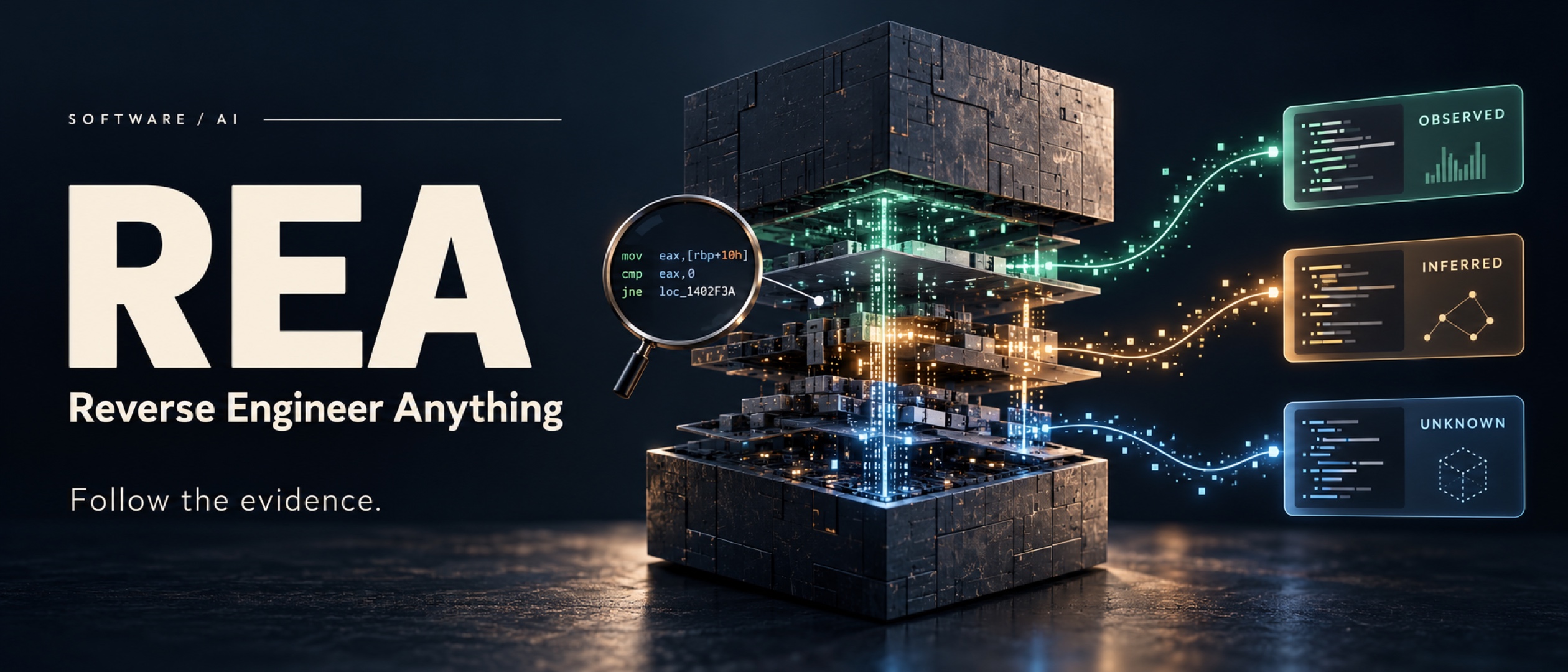
There’s an open-source project called REA — Reverse Engineer Anything — and it has become the center of a very familiar debate: if AI can understand compiled software, is closed-source software basically done for?
The name makes people want to make sweeping claims. But the more useful questions are much more specific: what does REA actually inspect, can it reconstruct an entire product, why is it getting so much attention, and would it help someone building a similar app?
What reverse engineering really means
Think of a finished app like a cooked meal. The source code is the recipe. Users only see the final dish, while the recipe may remain private. Reverse engineering means looking at the finished result and working backward to understand the ingredients and the method behind it.
For software, that means looking at a compiled program and trying to figure out how it was originally put together. You don’t get the original source code. You get clues instead: machine code, bytecode, metadata, strings, imports, function calls, and the pattern of data movement. From those clues, you try to rebuild a picture of what the program does and how it does it.
REA fits right there. It is not magic. It is a tool that tries to automate part of that detective work with AI.
What REA actually inspects
REA does not magically read the developer’s original recipe. Instead, it looks at what is already in front of it: compiled binaries, bytecode, symbols if they are still present, embedded strings, library calls, control flow, and other artifacts left inside the software.
From that, it can help identify things like:
- what functions probably do;
- which libraries or frameworks were used;
- how different parts of the program talk to each other;
- what kind of data structures might be in play;
- where certain features may live in the code.
So it is less like “here is the original source code” and more like “here is a smart reconstruction of what this thing probably looks like.”
Can it recover an entire product?
Not really. Not in the way people imagine.
A real product is more than just code. It is the build system, the assets, the server-side logic, the configuration, the third-party services, the deployment setup, the database design, the business rules, and all the little decisions that never made it into the code comments.
REA might help you understand parts of a compiled app. It might even help you rebuild some functionality. But recovering an entire product — especially a modern one — is a much bigger job. And even when it is technically possible, there are legal and ethical lines you do not want to cross.
Why it is getting so much attention
Because AI changes the economics of reverse engineering.
Before, this kind of work was slow, expensive, and required serious expertise. Now AI can speed up pattern recognition, summarize behavior, and help make sense of messy low-level code. That makes people ask a scary question: if AI can understand compiled software well enough, does closed source still protect anything?
That is why REA gets attention. It touches a nerve. It suggests that the moat around proprietary software might become much shallower.
But attention is not the same as proof. Hype loves a simple story: “AI can reverse anything, so closed source is dead.” Reality is much messier.
Would it help someone building a similar app?
It could help — but probably not in the way you hope.
It might be useful for:
- learning how a certain technique works;
- debugging interoperability issues;
- security research;
- checking whether your own software leaks too much information;
- understanding legacy systems you have inherited.
It is much less useful as a shortcut to clone someone else’s product. You still need to design your own app, test it, maintain it, and deal with everything that is not in the binary. And if you copy too closely, you are not just risking bad code — you are risking legal trouble.
The realistic conclusion
AI makes reverse engineering faster and more accessible. That is a real shift. But it does not make closed-source software pointless overnight.
Source code was never the only moat. Execution, data, community, trust, brand, speed, and distribution matter just as much. REA is interesting because it pushes on one part of that wall — not because it knocks the whole thing down.
Bottom line
Reverse engineering is no longer a niche skill performed only by specialists with expensive tooling. AI has lowered the cost of investigation, which is a meaningful change. But the bigger lesson is not that proprietary software is dead. It is that the cost of understanding it has fallen, while the cost of building and differentiating your own system remains very real.