Muse, Mods, and Dots: Three Very Different Ideas About AI Agents
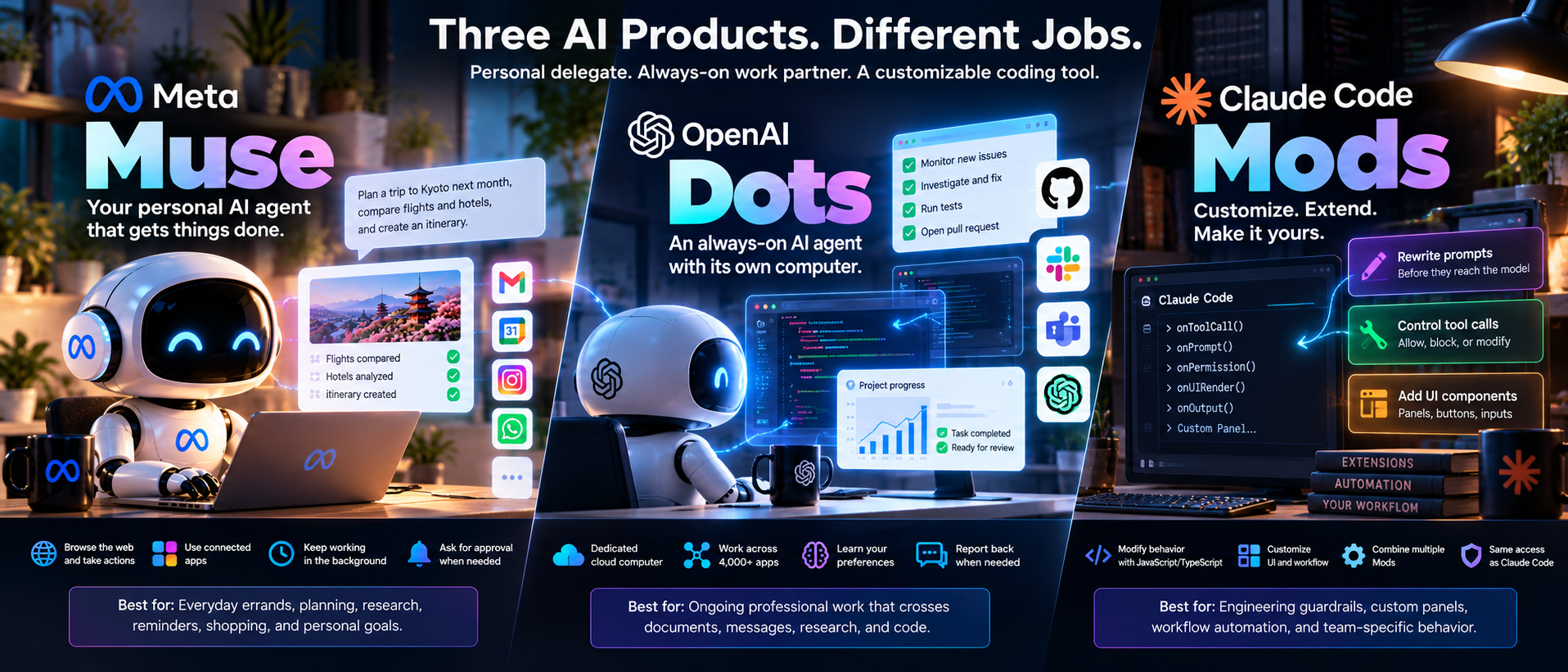
Meta Muse, Claude Code Mods, and OpenAI Dots are often placed in the same conversation because all three point toward a more active kind of AI.
That is where the similarity ends.
Muse is a personal agent. Dots are persistent agents for ChatGPT. Mods are a way to rewire Claude Code itself. Putting them on one feature checklist makes Mods look like the odd one out—and it is. Mods are not a personal assistant and they are not a worker you delegate a weekend task to. They are closer to an extension layer for an AI coding tool.
The useful comparison is not “which one is smartest?” It is “what is being changed?”
- Muse changes who does the work in your personal life.
- Dots change how ongoing work is delegated inside ChatGPT.
- Mods change how an AI developer tool behaves while it is working.
The short version
| Product | What it is | Where it works | Best fit |
|---|---|---|---|
| Meta Muse | A personal AI agent that can browse, use connected apps, and continue tasks in the background. | Muse’s app, WhatsApp, and its dedicated cloud computer. | Everyday errands, planning, research, reminders, shopping, and personal goals. |
| OpenAI Dots | An always-on ChatGPT agent with its own cloud computer, connected apps, and persistent responsibilities. | ChatGPT, Slack, Teams, and a dedicated cloud environment. | Ongoing professional work that crosses documents, messages, research, and code. |
| Claude Code Mods | TypeScript or JavaScript extensions that intercept events and customize Claude Code’s workflow and UI. | Claude Code’s CLI and desktop Code tab, with partial logic support elsewhere. | Engineering guardrails, custom panels, workflow automation, and team-specific behavior. |
The first two are workers. The third is a power tool for customizing a worker.
Muse: the personal delegate
Meta’s Muse is aimed at the broadest audience of the three. The expected user does not need to know what a tool call or virtual machine is. They should be able to describe an outcome in a message and let Muse figure out the steps.
Meta’s examples include booking appointments, filling out forms, organizing research, creating documents, tracking a goal, and making a purchase after approval. Muse can connect to services such as email, calendars, and Instagram. It can also keep working after the user closes the app and return when a decision is needed.
The product’s key idea is continuity. Muse remembers what matters to a person and can use that context later. A recipe saved on Instagram might become a shopping list. A training plan might be adjusted when the user’s schedule changes. A recurring reminder might continue without a new prompt every week.
That is the promise—and the risk. A personal agent becomes useful by knowing more about you. The user needs to understand exactly what it can read, what it can change, what it remembers, and which actions require approval.
Meta says Muse runs in a dedicated Muse Secure VM, with a separate Sentinel agent controlling internet access and a visible audit trail for actions. Credentials are stored so Muse can use them without seeing the underlying passwords. Meta also says users can disconnect apps, change permissions, ask Muse to forget specific memories, and opt out of their interactions being used to train Meta’s models.
Those controls are not side features. For Muse, they are part of the product itself.
Dots: the always-on work partner
OpenAI’s Dots are aimed more squarely at work. A Dot gets its own cloud computer and browser, can connect to more than 4,000 apps through ChatGPT’s ecosystem, and can be reached through ChatGPT, Slack, and Microsoft Teams.
The intended jobs are not just “summarize this.” OpenAI talks about watching bug reports, tracking a budget cycle, investigating a slow app, migrating an old API, and opening pull requests for human review.
That makes Dots feel closer to a junior operations team than a personal assistant. You give the Dot a responsibility, define what it may do independently, and expect it to make progress between conversations. It can learn preferences over time and report back when a decision needs a person.
ChatGPT Space adds a shared place for the work. People, files, pages, and Dots can occupy the same project context. A teammate can mention a Dot in a comment, assign a recurring check, or ask it to update a page from a Slack channel.
The important distinction is between the agent and the workspace:
- The Dot performs the work.
- ChatGPT Space holds the context where people and agents collaborate.
OpenAI is therefore selling more than a smarter assistant. It is proposing a different way for a team to keep work moving when nobody is actively watching the screen.
Mods: the toolmaker’s layer
Claude Code Mods solve a different problem entirely.
A Mod is a TypeScript or JavaScript function attached to an event inside Claude Code. It can rewrite a prompt, intercept a tool call, approve or reject a permission request, hide secrets from tool output, or draw a new panel or button in the interface.
That makes Mods useful for rules that a team does not want to leave as a polite instruction in a README. A Mod can pause before a force push, show the likely blast radius of rm -rf, require confirmation before touching production, display CI status beside the conversation, or record the calls made by other Mods.
Mods also change the interface. A team can add a Next Steps menu, a context-window indicator, or a replay command for walking through Claude’s previous file changes. The result is a Claude Code environment shaped around the team’s habits rather than the defaults shipped by Anthropic.
The catch is significant: Mods run with the same computer access as Claude Code and are not sandboxed. A Mod can read and write files, launch programs, make network connections, inspect environment variables, and potentially approve tool calls. Installing one is a software-trust decision, not a cosmetic customization.
This is why Mods should not be described as a competitor to Muse or Dots. They are the mechanism that lets an engineering team decide how an AI coding agent is allowed to behave.
One comparison that actually helps
The cleanest way to compare the three is to follow a task from intention to execution.
1. The user has a goal
With Muse, the goal might be “find a good restaurant for Saturday and make a reservation once I approve it.”
With Dots, it might be “keep the migration project moving and update the team every morning.”
With Mods, the goal is usually not handed to the extension at all. The developer asks Claude Code to work on a repository, and a Mod changes the conditions around that work.
2. The system finds a path
Muse is expected to plan across personal services and the open web. Dots can coordinate work across connected business tools, documents, messages, and code. Mods do not plan a project in that sense; they intervene at the points where Claude Code calls a tool, asks for permission, or renders output.
3. The system acts
Muse acts as the user inside its Secure VM. Dots act as a persistent coworker inside their cloud computer and connected apps. Mods act inside the developer tool, often before the agent reaches the outside system at all.
4. Someone needs to approve the risky part
Muse and Dots are designed to stop before sensitive actions such as purchases, sending messages, or sharing information. Mods can enforce approval rules for engineering actions, but a poorly written Mod may also have enough access to weaken the workflow it was meant to protect.
That last difference is easy to miss. Muse and Dots come with an agent experience. Mods give developers a programming surface and ask them to take responsibility for the consequences.
Which one should you use?
Choose Muse if the problem follows you home
Muse makes the most sense for personal tasks that cross calendars, shopping, reminders, research, and communication. It is designed to reduce the small administrative jobs that accumulate during a week.
Its success will depend on whether the permission model feels understandable enough for normal users. A personal agent should be easy to delegate to and easy to stop.
Choose Dots if the work belongs to a team
Dots are a better match for recurring professional work: monitoring projects, triaging issues, maintaining documents, following up in Slack, or coordinating several tools over time.
The dedicated computer is important here. A team may not want an agent running inside an employee’s personal session, and it may need a clear place to review logs, files, and credentials.
Choose Mods if the problem is your development workflow
Mods are for teams that already use Claude Code and have opinions about how it should operate. They are especially useful when a rule needs to be enforced at the moment of action: do not touch production, do not leak secrets, show the blast radius, run the tests, or require a second look before a destructive command.
Mods require more technical judgment than the other two products. They are code, they run with real permissions, and they need versioning, review, and a trusted distribution path.
The real overlap: delegation needs boundaries
Muse and Dots are trying to make delegation feel natural. Mods are trying to make the boundaries around delegation programmable.
That is why these products belong in the same conversation. All three assume that the next useful interface for AI will not be a blank prompt box. It will be a system with memory, tools, background work, and rules about when to stop.
But the trust model is different:
- Muse asks for access to a person’s life.
- Dots ask for access to a person’s work.
- Mods ask for permission to shape an agent’s actions on a computer.
Those are three different risk surfaces. They should not be evaluated with the same checklist.
Final take
If I had to reduce the comparison to one sentence, it would be this: Muse is the delegate, Dots are the coworker, and Mods are the workshop rules.
Muse is the most personal. Dots are the most operational. Mods are the most programmable—and the easiest to underestimate.
None of them removes the need for judgment. The interesting shift is that judgment is moving earlier in the process. Instead of checking every tiny step, people set the goal, define the boundaries, and review the moments where an action becomes consequential.
That is probably where agent software is heading. The winning product will not be the one that promises to do everything. It will be the one that makes it obvious what it is doing, what it is allowed to touch, and when it needs you back in the loop.
Sources and notes
This comparison draws on Meta’s Muse announcement, the Muse product overview, OpenAI’s Introducing dots, the DevDay 2026 recap, and Anthropic’s Claude Code Mods announcement. Features, plan availability, and rollout details may change as these products develop.